

Tanat Valley 3 by Peter Drost
I’m no great shakes when it comes to painting rolling stock. So anything that makes the job easier and reduces the scope for mistakes is likely to be a good thing.
The first requirement, all the books and articles agree, is that the paint must be well mixed. But painting models isn’t like putting another coat of Dulux on the kitchen walls—the little tin of precision-matched Midland Red may have been waiting years for you to get round to finishing the engine it was bought to adorn, and when you prise the lid off it will probably have separated.
Mixing paint in a 14cc tinlet with a screwdriver is awkward, messy and ineffective; inevitably, paint is wasted, and there’s a risk of contaminating the tin. I think we need a better way.
The better way is to mix the paint before you open the tin, and the way to do this is by shaking it. This cannot be done by hand, but it can be done very effectively by machine. There is, or was, a machine you can buy to shake tinlets, but if it’s still on sale it’s probably quite expensive, and I don’t know whether it does 50cc tins.
I made myself a paint mixer from an old hand-held electric jigsaw. I know it’s old, I bought it secondhand 15 years ago. No electrical modifications were necessary, and in fact there was no need to open the works at all.
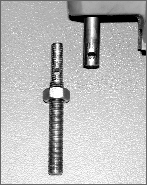 Photo 1
First I took off the shoe—one screw—and the blade holder—another screw. I was left with a steel tube, and 6.7mm bore, wih a hole across it. Then I cut off a 70mm length of M8 steel studding, which is readily available, even in mid-Devon. A largish M8 bolt would do just as well. Then I turned 20mm of it down to 6.6mm diameter. I used a lathe, but you could do the job quite easily with a vice and file. Precision is unimportant; you just have to get it to go up the tube. Then I drilled the thinner part across 4mm for a locking bolt.
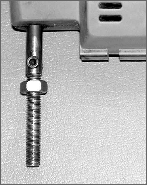
Photo 1 shows the piece part, and Photo 2 shows it assembled to the jigsaw. And that is the most difficult part done.
(It is possible that other makes of jigsaws have different ways of attaching the blade, but it ought not be too difficult to devise a way of attaching a piece of screwed rod where the blade used to go. In extremis you could even get somebody to weld an old saw blade to the studding for you, and use the original blade clamp. It doesn’t have to be neat or symmetrical, just strong!)
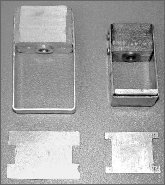
Now we need a carrier to hold the tin of paint. This consists of a die block, to screw on to the studding, a strop firmly fixed to it to hold the tin, and a pressure plate to clamp the tin. Photo 3 shows two I made, one for a tinlet and one for a 50cc tin. (You could get by with one 50cc size, and use a packing block with the tinlets.) The die blocks are of wood, and the strop and pressure plate of sheet aluminium. In the ones illustrated I fitted M8 threaded aluminium bushes in the wooden die blocks, but it is quite possible to screw the studding directly into the wood, provided the hole is the right size—drill 7.5mm and open the hole out with a round file until you can just screw the threaded rod through. Or you could glue an M8 nut into the inner side of the die block; a 15mm hole is about right. Equally, pressure plates of hardboard will serve instead of aluminium. It is very important, though, to secure the strop firmly to the die block. Mine are screwed and glued with epoxy.
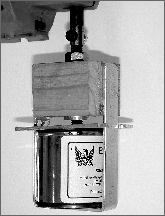
In use, just fit the unopened tin centrally into the carrier between the strop and the pressure plate, either way up, screw the carrier up the studding until the tin is securely held, and tighten up the lock nut to prevent the carrier unwinding. Then switch on. This machine really shows the tin who’s boss, and I find that a minute’s shaking usually gives very well mixed paint.
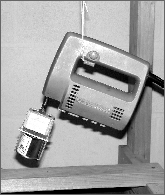
One last point. Because the oscillating mass is now much greater, the body of the saw vibrates, making it uncomfortable to hold. There is no need to put up with this. Just hang the saw up on a nail with a loop of string, and turn it on and off at the wall socket. Perfect painless paint mixing!
Top
Tanat Valley 3 by Peter Drost

John Borkowski converts Accurascale hopper wagons to S7

The Story of Reeth by Simon Caygill
For further information on the ScaleSeven Group, or if you have any questions: