

Tanat Valley 3 by Peter Drost
Tony Kell has kindly given permission for this article about his ScaleSeven layout to appear here. All photos are by Mike Bisset.

A loaded mineral train hauled by the Class 20 departs from Burdale Quarry. The Class 20 is a JLTRT kit which has a Zimo Activedrive sound decoder installed.
BURDALE QUARRY is my latest foray into building portable layouts in ‘O’ gauge. Initially, I created two layouts depicting the London and North Eastern Railway just before nationalisation, but in recent years I have been building American narrow-gauge layouts. However, I decided I needed a change of scene once more. In doing so, I came back to British Railways and the 1970s as this is what I remember as I am only a youngster of 60! This meant building all-new locomotives and stock, so I took the plunge into ScaleSeven at the same time.
It appears that many people don’t want to give ScaleSeven a try because they have so much finescale stock already, and I must admit that I was one of these. I still have all my finescale stock for use at my local club (the Normanton & Pontefract Railway Modellers Society), but I am slowly building up a more modern fleet of locomotives and wagons specifically for this 33mm gauge layout. I have also built ScaleSeven bogies for some of my previous finescale models so I can run them on my new layout and the club layout by swapping the bogies.

A view across the tracks with 06009 disappearing into the storage yard behind the quarry buildings while 20043 waits in the quarry siding.
It all began while out walking in the Yorkshire Wolds near Wharram Piercy. I passed an old tunnel and a quarry, and this gave me an idea for a future layout and planning began. I used countless rolls of wallpaper backing paper to draw out various designs full size until I was satisfied I had the plan I needed. After about a month in the planning, I made a start on the layout. It took just over a year to complete. The layout depicts a small quarry.

There was a Burdale Quarry located on the Beverley to Malton line just south of Wharram Piercy. Between the 1920s and 1950s, the line was used for transporting chalk from the Burdale and Wharram quarries. Passenger services ended in 1950. Burdale quarry closed in 1955, and the line closed completely in 1958.
I have used artistic licence to firstly extend its use into the 1970s and build the quarry and station in a manner that never existed. The quarry was unusual for Yorkshire as, instead of the usual limestone, it quarried chalk which I understand went to ICI at Billingham over the North Yorkshire Moors.

A mineral wagon is shunted under the loader by the Class 20 while the Class 08 waits in the arrivals road.

The Cravens Class 105 DMU emerges between the quarry buildings while the Class 20 waits in the sidings with a loaded mineral train.
The track is all hand-built track using C&L components and Just Like the Real Thing (JLTRT) tie bars on the points. For a while, the tie bars were not available but are now once again produced by MM1 Models. These are operated by servo motors discretely hidden inside the buildings at the rear. The servos are linked to the point operating rods. The track plan was pasted to the boards and the sleepers were then glued down with PVA glue. The rails were then threaded with chairs and fixed in place using a suitable solvent and ScaleSeven gauges to ensure accuracy.
Every piece of rail had a piece of wire soldered to the underside of it before fixing down. This wire was threaded down through a small 1mm hole drilled in the baseboard next to the rail. The track was then painted using a mixture of enamel paints and the rail tops were then polished clean. Next, the track was ballasted using Woodland Scenics coarse and medium ballast which was carefully teased into place with a dry paintbrush and then fixed down using watered down PVA adhesive. Once all the track had been completed, the dropper wires were connected to a pair of bus bars under the layout to provide track power. The track was then tested using a newly completed JLTRT Class 20 and after a bit of fiddling, all was well. This was then sprayed with an airbrush to make it look dirty and dusty.
Servo motors operate all the points. The servos are driven by a Tam Valley Octopus control board which is controlled by a mimic switch panel fixed to the rear of the layout. Using this method of point control, the throw of each blade is set up manually to throw precisely the correct amount so there is no forcing anything.

A light train arrives at the quarry hauled by the Class 31. The conveyor above is disused and is modelled in a dilapidated state.
Dummy point rodding from Model Signal Engineering has been added and these run to an open platform mounted lever frame from Invertrain. The signals are colour lights and ground signals. The ground signals operate from auxiliary microswitches attached to the servos and automatically switch with the operation of the points. Switches on the mimic control panel control the other signals.
The buildings are all scratch built using a 3mm plywood shell overlaid with Slaters Plastikard brickwork and corrugated sheet. The corrugated sheets were cut into appropriately sized sections and each piece then fixed in place with the assistance of my grandson, John.
If you ever visit the Yorkshire Wolds, you will see bare topped rolling hills with thousands of trees lining the old railway lines. I have attempted to depict this in my layout. I am not particularly good at modelling trees, but I was lucky enough to know a man called Charles Shearn who loved making them. Sadly, Charlie passed away at the end of last year, but his trees still do excellent service on my layout.
The hills are carved from building insulation blocks and glued to the baseboard using grab adhesive. These were cut to shape with a bread knife and then coated in Artex which is painted with a variety of emulsion paints. Horizontal surfaces were flocked using various branded flock and glue applied with a Green Scene electrostatic sieve. The oil tank in the yard is from a Skytrex kit suitably modified with an additional brass walkway. The fencing surrounding the yard is made of brass angle drilled and painted and inserted into the board. Fine wire was threaded through the holes in the angle and millinery netting (used by hat makers) was used to depict the chain link fence. This was stitched in place.
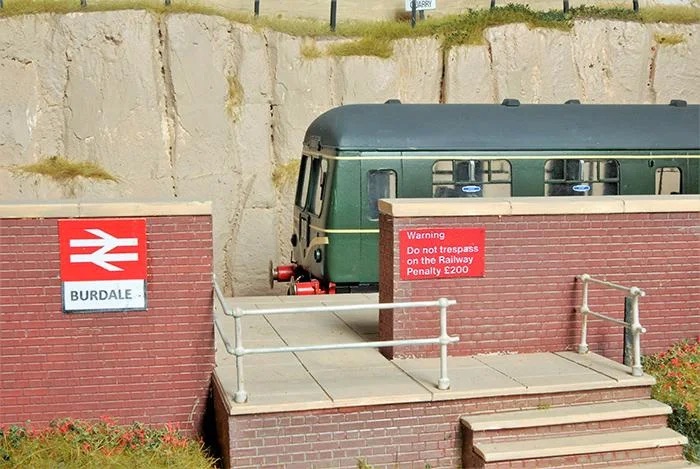
At the single-platform station, the Class 105 waits for passengers to arrive.
I have built a small set of locomotives to ScaleSeven standards specifically to operate on Burdale Quarry. These consist of a green Class 31, a BR blue Class 06, a BR blue Class 20 and a green Class 105 Diesel Multiple Unit. In addition, I have modified the wheels of a Dapol Class 08 to ScaleSeven standards, and it runs a treat. All the locomotives are fitted with Zimo Digital Command Control sound chips that are designed for ‘OO’ gauge models. They have Activedrive which is a system where you must brake the locomotive to make it stop – you must keep your wits about you now – which enhances the experience of running the layout. In terms of rolling stock, I have a pair of Buzz Models FGAs with a couple of 20ft containers on together with an ISO tank with a Bulkhaul logo that I created the transfers for. I have several Parkside Dundas 10ton mineral wagons and a Parkside Dundas NE brake van. All are fitted with three-link couplings. Under construction are a couple of BR Fish vans for passing traffic.
My layout has now appeared at shows locally here in Yorkshire and one in Glasgow too (where it was photographed for Hornby Magazine) and is due to appear again at the Hull exhibition. When it appeared earlier this year at the Howden show, my grandson John, who was only eight at the time, came to assist me. He had a ten-minute course on how to operate the layout including coupling/ uncoupling the three-link couplings, the sequence of operating and handling the stock in the storage yard. He then ran the layout by himself most of Sunday, declining all offers to take over operation.

The smallest locomotive on the layout, a Class 06 0-4-0 diesel shunter, passes through the double slip with a couple of bogie bolster wagons.
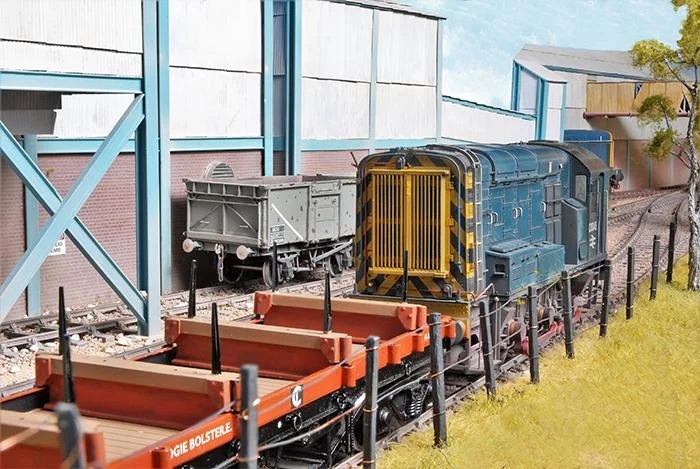
The Class 08, a regauged and sound fitted Dapol model, shunts two bogie bolsters in the quarry arrivals siding.

The Class 20 20043 draws a train of loaded mineral wagons forward
Having built this layout, I am happy with the running qualities of ScaleSeven, but I cannot say it is any better than finescale. Many told me that ScaleSeven does not work or that it is only for showcase models. I’m sorry, but I do not agree. It works just the same as finescale. From a distance, you cannot tell the difference - the only clue is when you look at the pointwork.
Tony Kell was Vice-Chairman of Events for the Gauge O Guild and a very nice man. He put this layout up for sale in early-July 2023 knowing that his time was limited having been diagnosed with an inoperable condition back in March. He was keen to make sure that his wife did not have the extra burden of disposing of the layout on his death.
Sadly, Tony passed away on 17th August 2023 at the young age of 66.
The layout and all stock was purchased by Dave Summers (the S7 Webmaster) in mid-July 2023 and it is hoped to exhibit the layout in its unaltered form in the coming months and years as a tribute to Tony and his modelling.
Top
Tanat Valley 3 by Peter Drost

John Borkowski converts Accurascale hopper wagons to S7

The Story of Reeth by Simon Caygill
For further information on the ScaleSeven Group, or if you have any questions: