

Tanat Valley 3 by Peter Drost
This article was originally published in the ScaleSeven Newsletter 102 in November 2015
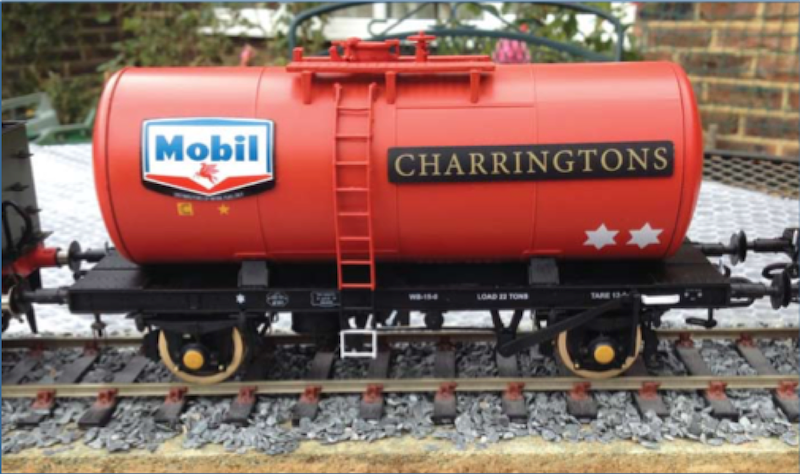
The Heljan B 4-wheel tank car represents a reasonable, although not perfect, model of the 35.5 ton tank car that was used extensively in the 1950s and 1960s by the UK oil industry to distribute finished petroleum products by rail in the UK oil market. In 4mm scale it was well known and represented by the Airfix Esso Petroleum model kit that I believe is still available today in various forms from Dapol.
The Heljan model has a sprung chassis and sprung buffers. The screw couplings are also sprung. If you are prepared to accept its inaccuracies such as overscale axleboxes, the model is suitable for conversion to S7. The wheels in S7 are a tight fit and the inside faces of the axleboxes and bearings have to be thinned down if S7 conversion is to be successfully achieved.
Heljan originally offered its 7mm tank car version in seven variants as a limited production run with all stock now issued to retailers:

At the date of writing this text (end-July 2015), all versions except Esso black full labelling are still available from Tower Models and some others from Hattons.
Oil trains have always been a great interest to me. I purchased a total of fourteen wagons, mainly in Mobil Red, as I wanted a complete train. Five of these I have already successfully converted to S7. I was especially interested in the Mobil Red version as I remember them in trains serving the Mobil Coryton Refinery in the late 1950s when my family lived near the depot loading site. My father worked for Mobil at the refinery at that time and as a boy I was always a great Mobil enthusiast.
It seems that the Heljan Mobil tank wagons are less popular than the Esso ones; so, if you are interested in them or the other versions, you need to buy them soon before they all disappear. If you cannot get the exact model you want you could always respray and re-label Heljan models to meet individual needs. I would have liked a Shell Mex and BP version.
If you want a close to perfect model of this vehicle in 7mm, I would recommend the David Parkins etched brass kit, several of which I have also purchased and hope to report in a later article on its construction progress. I plan to build a few of these wagons with Shell Mex and BP livery that I remember still in service when I started work at BP in the 1970s.

The Heljan tank wagon has a fully sprung chassis with miniature coil springs located in the W-irons pressing down on the moulded plastic roller bearing axleboxes.
The Heljan wheels need to be removed and turned down to S7 dimensions on a lathe. Colin Dowling offers an excellent commercial service for this work at a reasonable cost. If demand is not too great, I can also do this for you for a nominal charge on my Proxxon lathe on request.
If you have no access to a lathe, or if it works out cheaper than commercially turning down the Heljan wheels, it is possible and easier to use Slater’s S7 wheelsets.
I have tried this solution on one wagon and it worked very successfully without needing to file down the axleboxes. The Slater’s S7 axle ends are a much smaller diameter than the Heljan axles so they cannot be used with the Heljan bearings.
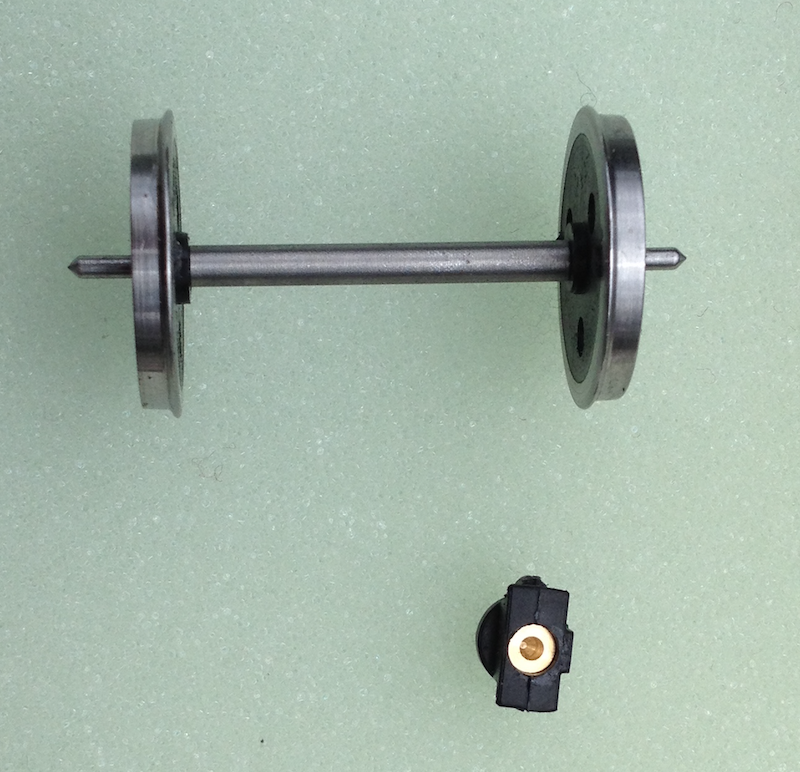
Where using Slater’s wheels and axles, the Heljan bearings need to be pulled out of the axleboxes and be replaced with the smaller Slaters bearings.
These fit nicely into the Heljan axlebox bearing holes. The only drawback when using the Slaters S7 wheels is that wheel centres rub on the plastic Heljan axleboxes as the Slaters bearings are recessed in the Heljan axleboxes. While this is not ideal engineering practice, it should be satisfactory for light or medium running use, i.e. on the majority of layouts.
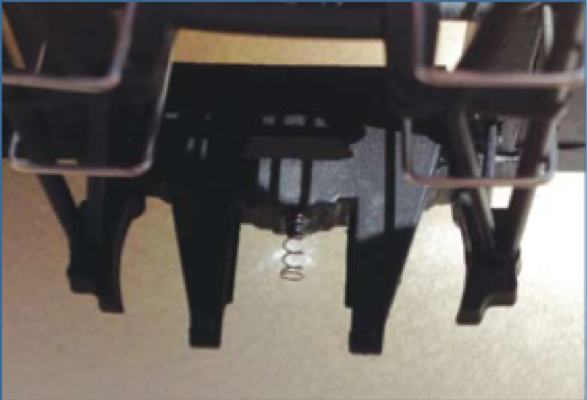
To remove the existing wheel sets it is necessary to remove the plastic keeper plates at the bottom of each W-iron. This needs to be performed very carefully as it is very easy to lose the springs. They are very small and easily ping off into the distance. Once gone, they are very difficult to find. I lost one and had to acquire another from the Heljan importers Howes of Oxford, but they no longer hold any more spares.
It may be possible to use suitable springs from other sources. Slater’s have been mentioned as a possible supplier, but I have no experience of using their products in this application. If you lose one spring you need to make sure that the replacement has the same properties as the remaining three. It may be best to replace all four springs if you lose one to ensure that they all have the same properties.

With this known risk of losing springs, I chose to glue with superglue (cyanoacrylate) the springs on the upper end to the W-irons before removing the axlebox-wheelsets assemblies on the other wagons, but after removing the keeper plates.
Take special care not to get glue on the axle boxes and/or the W-irons as, if you are not quick here, you can inadvertently lock the axleboxes in the W-irons and destroy the suspension springing action.
Watch out as superglue can easily flow onto the W-irons without you noticing.
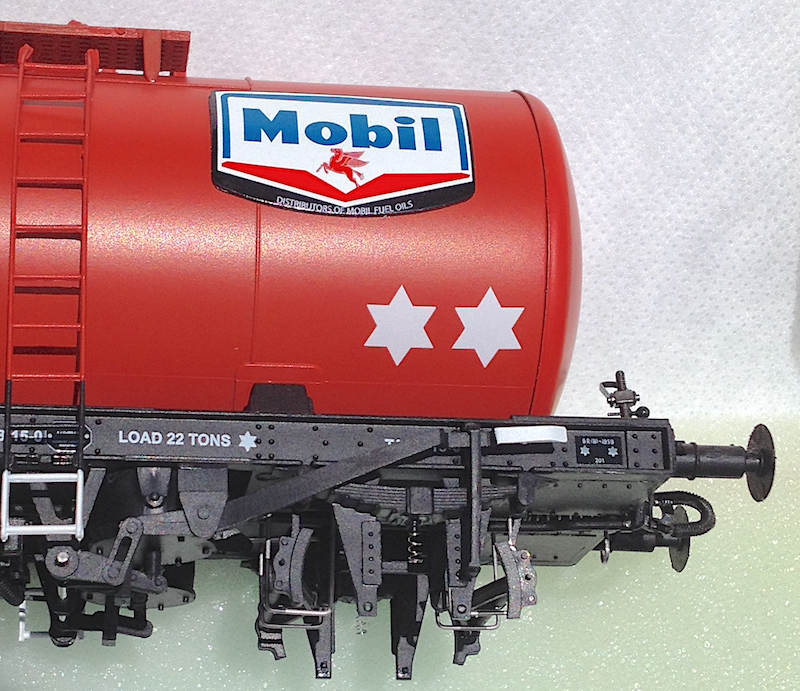
The keeper plates were levered off using a scalpel blade fixed in a scalpel knife holder.
When the superglue was dry on the springs, I removed the axleboxes off each side and took out the wheelsets removing each wheel by pulling them off each axle for turning on the lathe.
I used a GW Models extraction tool to pull the wheels off the axles. This needs to be done carefully so as not to distort the plastic insulated bushing in each wheel.

Each wheel needs to be thinned to 3mm by turning off the wheel face and reducing the flange to S7 standards using the S7G wheel flange turning tool.
The Heljan wheels are made in blackened brass and turn very well on a good quality lathe. After they are turned, if necessary, they can be blackened again using Birchwood Casey Gun blackening liquid available from Eileen’s Emporium. I chose to leave all mine in finished machined brass.

The plastic keeper plates have circular extensions moulded on them fitting into holes drilled in the W-irons. Sometimes it was possible to extract them cleanly from the W-irons, but usually at least one extension became stuck in the W-iron hole and broke off.
If this happens it is possible to drill an appropriately sized hole c0.75mm in the plastic keeper plate to take a short length of brass rodding to ensure that the keeper plate is properly secured to the W-iron.
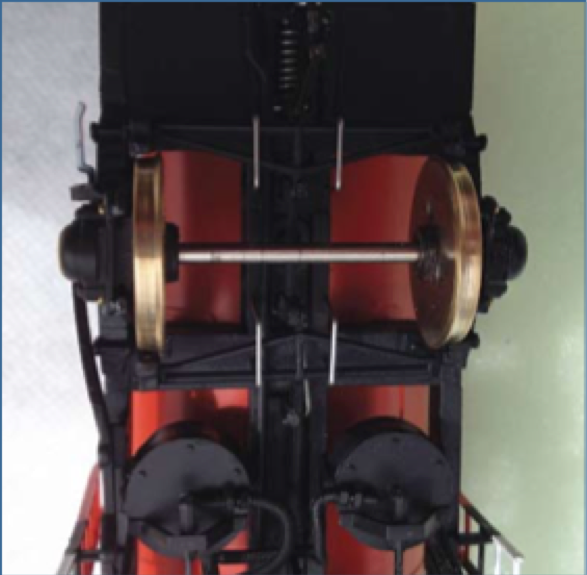
When the Heljan wheels are turned to S7 dimensions they need to be refitted by pressing back on the axle and spaced to S7 using an approved S7 back-to-back gauge.
When the Heljan axles with the turned S7 wheels are placed into the axleboxes, they are too tight to slide freely into the W-irons.
This means that the axlebox inner faces together with the fitted brass bearings need to be filed down in order to create a smooth sliding fit in the W-irons.
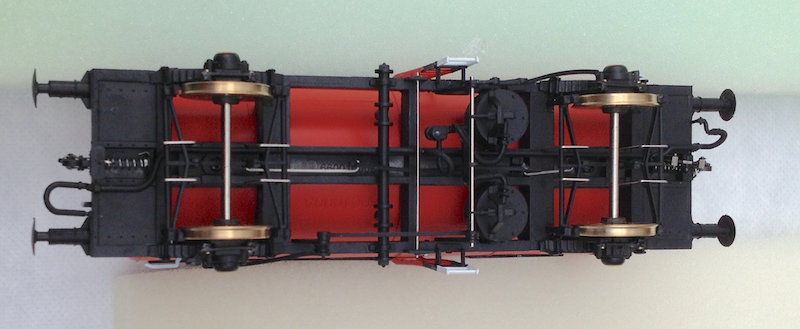
It is necessary to gradually file down each axlebox in turn equally to achieve a good fit. It is best to use a high quality flat fine metal file. I used a very fine, large Sandvik file in my possession, which works very well.
Take a little bit off in turn on each axlebox. Try to ensure that the surface remains square and flat. Don’t overdo it.
It may be necessary to remove the brass bearings from each axlebox. I found some were loose while others were a tight fit in the plastic axleboxes. This phenomenon does seem to vary with different wagons.
So, it seems the moulding production tolerances were quite wide on the axleboxes. I found the fit was about right when the flange on the bearing was only just existent.
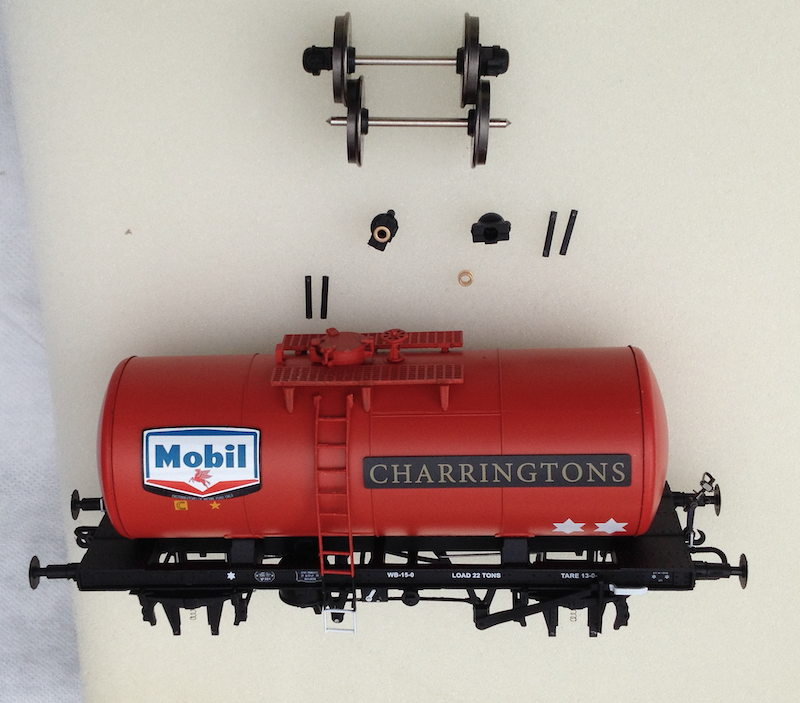
If necessary use a pair of pliers to extract the bearings, but please use care in this operation not to spoil (distort) the bearings.
If the bearings are tight in the plastic axleboxes they can be filed down as a single unit. Remove all swarf (both plastic and metal filings) from each axlebox before refitting the wheelset axles and placing the assemblies into the W-irons.
Also, if the bearing is a loose fit in the axlebox once all the filing is complete, it is a good idea to superglue the bearing back into the plastic axlebox prior to replacing the wheelset-axlebox assemblies finally into the W-irons.
The axleboxes with the wheelsets installed need to have a good sliding movement with the springs in the W-irons. Lateral movement should be avoided other than the minimum for a good sliding fit.
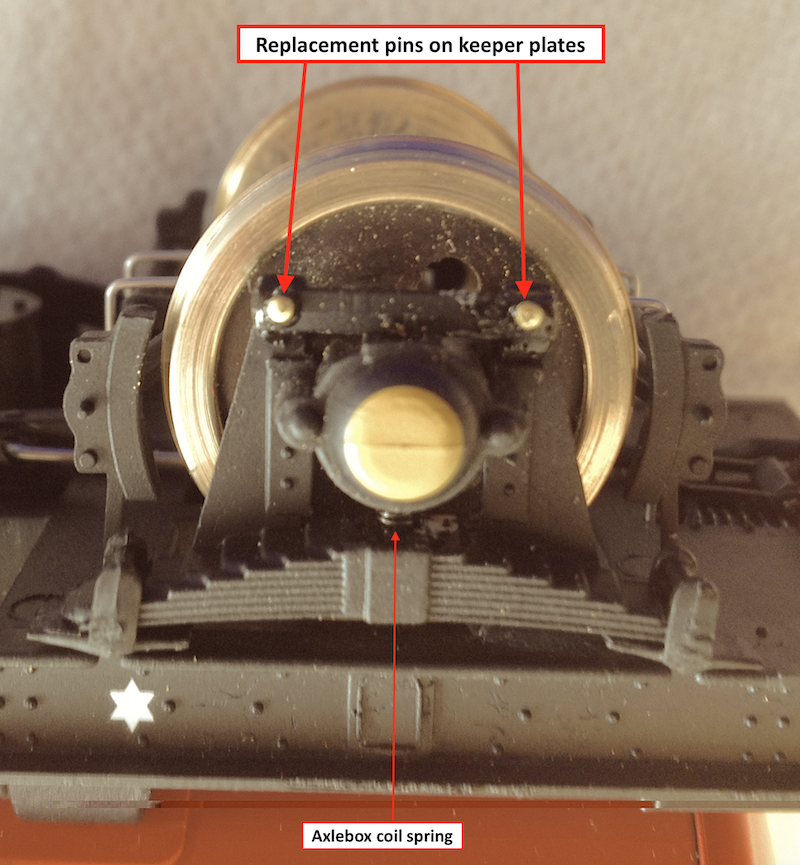
Before replacing the axlebox-wheelsets assemblies permanently in the W-irons, preparation for replacing the axle keepers is required. It is best to drill out the holes at the bottom of each W-iron and then either refit the plastic keeper plate or use a brass replacement.
I used both solutions. The plastic keepers were drilled to match the W-iron hole spacing and had a fine brass rod inserted at each end fixed with superglue. When I used brass keeper plates I again drilled using a pillar drill and then used short lengths of thin brass rod (0.7mm) to hold them in place duly superglued after I had fitted the axlebox-wheelset assembly into the W-irons. I also used some fine brass pins on some wagons instead of brass rodding to fix the keeper plates. This gives a more secure fixing if you can tolerate the pin heads.
When a good sliding fit has been achieved on both axleboxes, slide the wheelsets plus axleboxes in and fit the keeper plates; either the plastic originals or replacement brass plates. Superglue into the correct position, but again be very careful not to get glue on the axlebox bearing surfaces of the W-irons.
If brass keeper plates are used, you will need to paint them black. If the brass rodding is visible even with the plastic keeper plates you could also paint them black. Before painting file the rodding back so it is not too obtrusive.
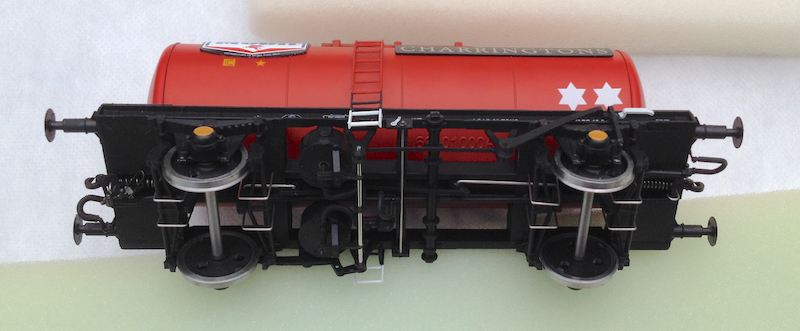
This is as described as in the 3rd paragraph of the section on Wheel Options. When the Slater’s axlebox-wheelsets are fitted permanently in the W-irons, the keeper plates need to be refitted as described in the section for refitting the Heljan wheels.
So far, I have converted three Mobil tank wagons (1 with Slater’s S7 wheels), 1 Esso wagon and 1 Regent wagon.
It is possible to mix wagons in common trains as different company wagons were used to fill at the same depots due to exchanges/swaps and cross-purchases amongst the different oil companies.
Tanat Valley 3 by Peter Drost

John Borkowski converts Accurascale hopper wagons to S7

The Story of Reeth by Simon Caygill
For further information on the ScaleSeven Group, or if you have any questions: