

Tanat Valley 3 by Peter Drost
A 1:20 gauge for 33mm S7 trackwork - holds the rail at the 'correct' angle.
Railway wheels are not cylinders (like a car tyre), they are conical to allow the vehicle to 'steer' around curves. The shape is a little more complex than just being a cone that but for simplicity lets assume they are a cone for the moment - Green in the picture below (exaggerated drawings for clarity).
If the coned wheels were to sit directly onto rails laid perpendicular then because of their shape the wheel contact would try to spread the rails apart. This would therefore require the rail fastening system to work harder on one side of the rail than the other to restrain the rails from rolling over.
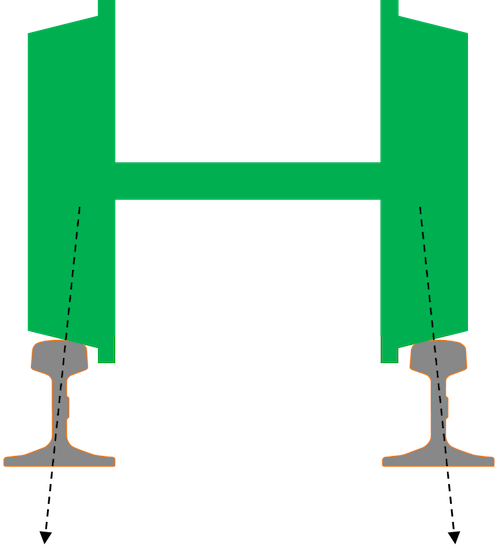
To minimise this rail spreading effect rails are often laid so they are tilted (inclined) slightly inward towards the centre of the track. This equalises the load through the fasteners and avoids the rails being spread apart in use.
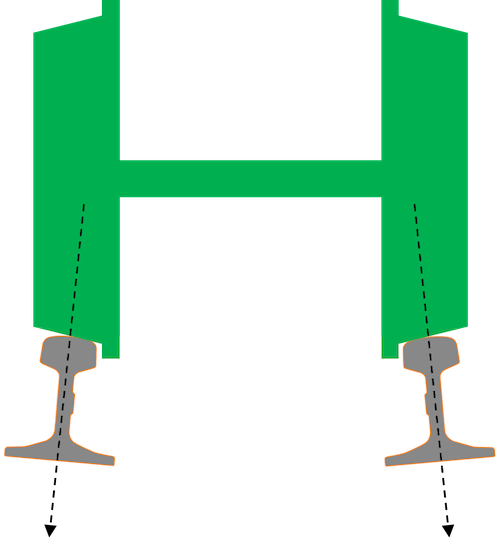
The angle of inclination is not universal around the globe and several different rail inclinations are common. 1:20 is used within the UK for example whereas in the USA 1:40 is used. 1:20 is used in most of Europe (with the exception of Denmark and Germany), Australia, Malaysia, Mauritania, Myanmar. Canadian Pacific Railway.
Top
Tanat Valley 3 by Peter Drost

John Borkowski converts Accurascale hopper wagons to S7

The Story of Reeth by Simon Caygill
For further information on the ScaleSeven Group, or if you have any questions: